
JHU/NIH Genetic Counseling Training Program
March 20, 2026 Update: Unfortunately, the JHU/NIH Genetic Counseling Training program will be sunsetting as of February 2027 and is not currently admitting students. This website is no longer being updated. For questions, please contact Megan Cho at megan.cho@nih.gov.
Drawing on resources from three outstanding research institutions, the National Human Genome Research Institute (NHGRI) and National Cancer Institute (NCI) at the National Institutes of Health (NIH) and the Department of Health, Behavior and Society at the Johns Hopkins University (JHU) Bloomberg School of Public Health have collaborated to develop and support the JHU/NIH Genetic Counseling Training Program (GCTP), a competitive graduate program that addresses the growing need for genetic counseling services.




Admissions
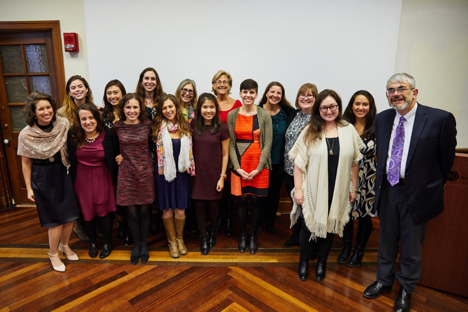
An applicant's potential to become a skilled, compassionate, and self-aware counselor is an absolute criterion for admission. The greatest consideration will be given to applicants whom we consider best able to advance the profession of genetic counseling through their leadership in research and their interface with the fields of public health, public policy and health education.
An admissions committee, composed of the Executive Committee, reviews the entire application package and considers the overall balance of each applicant's qualifications.
Unfortunately this year we are only able to take applicants who are U.S. citizens or permanent residents. Exceptions may be made for international (non-U.S. citizen) applicants with a prior doctoral level degree, such as an M.D. or Ph.D. If you think you may meet the advanced degree criteria and wish to discuss further, please contact the program admin at GCTPadmin@jh.edu for more information.
Requirements
- Completion of an undergraduate degree
- Completion of undergraduate level courses in biochemistry and genetics.
- Counseling experience, either paid or voluntary. This experience should provide the applicant with an opportunity to work with individuals in emotional distress and to reflect on that process.
In addition, prior coursework in psychology and statistics is strongly recommended.
The Johns Hopkins Bloomberg School of Public Health requires applicants from countries where English is not the primary, official language to submit scores on an English Language Proficiency Test.
The NIH/JHU GCTP does NOT require GRE scores or other standardized test scores. However, we will consider GRE scores if they are submitted as part of our holistic admissions review process.
Our admissions committee relies on a holistic review process, taking into account academic performance, counseling experience, other relevant work and life experiences, and the match between the applicant’s training goals and our program’s goals and objectives. Given this process, we do not have a specific GPA requirement. However, a strong academic background does provide the admissions committee with one helpful indicator of future success.
Deadlines
Applications must be submitted and completed by the December 1 deadline to be considered.
Invitations for interviews will be presented in February, with final decisions and offers made in April.
Diversity
The JHU/NIHProgram supports diversification of the genetic counseling profession. A diverse profession leads to a richer professional dialogue and enhances genetic counseling for minority communities. Therefore, candidates from a wide variety of backgrounds and experiences are welcomed. We especially encourage candidates from groups currently under-represented in the genetic counseling profession, including people with disabilities, men, and people from ethnic and racial minorities.
The Maryland and DC Society of Genetic Counselors (MDCGC) may have application fee reimbursements available for some prospective students. For more information and to apply for a reimbursement, please visit the Student Application Fee Reimbursement.
How to Apply
You should use the standard application form for the Johns Hopkins Bloomberg School of Public Health. You will be following instructions and deadlines for the ScM degree in the Department of Health, Behavior and Society. This application website will provide instructions for submitting all supporting documents, which include:
- Official transcripts from their undergraduate institution(s)
- curriculum vitae or resume.
- Three letters of recommendation (at least one of which should be an academic recommendation from an instructor or advisor).
- A personal statement.
- When appropriate, scores from an English proficiency exam.
- Official scores from the GRE exam (optional).
The Johns Hopkins/National Institutes of Health Genetic Counseling Training Program is participating in the Genetic Counseling Admissions Match through National Matching Services (NMS) beginning with admissions for Fall 2018. The GC Admissions Match has been established to enhance the process of placing applicants into positions in masters-level genetic counseling programs that are accredited by the Accreditation Council for Genetic Counseling (ACGC). The Match uses a process that takes into account both applicants' and programs' preferences. All applicants must first register for the Match with NMS before applying to participating genetic counseling graduate programs. At the conclusion of all program interviews, both applicants and programs will submit ranked lists of preferred placements to NMS according to deadlines posted on the NMS website. The binding results of the Match will be released to both applicants and programs simultaneously in late April.
Please visit the NMS website to register for the match, review detailed information about the matching process, and to view a demonstration of how the matching algorithm works.
*Please put your NMS match number in the header of your personal statement. *
Additional Inquiries
Specific inquiries regarding the program should be addressed to:
Lori Hamby Erby, ScM, Ph.D., C.G.C.
Phone: 301-443-2635
Email: lori.erby@nih.gov
Or to the Program Coordinators:
Ellie Younger
Phone: 301-439-6639
Email: ellie.younger@nih.gov
Last updated: August 21, 2024